
Thursday, February 27, 2014
It's a Bird! It's a Plane! No, It's Ubermensch!
Ubermensch: the ideal superior man of the future who could rise above conventional Christian morality to create and impose his own values. In Crime and Punishment, Raskolnikov is an ubermensch character in that he sees himself as superior to all the other characters. He believes he is above the moral obligations that all other people adhere to. When he commits the murders, he feels no pity or guilt for a large part of the novel. This lack of conscience is what qualifies him as an ubermensch. However, this theory is disproved when, at the end of the novel, Raskolnikov confesses to his crimes.

Yay Capitalism!
Capitalism: Capitalism is a political and economic system of governance in which a country's trade and industry are controlled by private owners for profit, rather than by the state. It is the opposite of communism. Crime and punishment showed a capitalist society as evil, with little to no positive aspects. Throughout the novel, Doystoyetsky continuously attacks the idea of a capitalist society, and shows affection to society with more communist-like qualities. This is a major theme in a lot of Russian
literature.

literature.
The Money's Trickling Down, Down, Down...
Trickle-down economics, simply put, is increasing the amount of money made by people in the top tiers of society so that they can invest that money back into the economy. Theoretically, it would increase the amount of jobs for people in the lower classes. It is believed that doing this would promote long-term growth with the increased job market. Luzhin mentioned an idea similar to trickle-down economics when he first meets Raskolnikov. 
Survival of the Fittest?
Social Darwinism is a social theory that connects Darwin's theory of evolution by natural selection and the social relations of humanity. Raskolnikov survives because he confesses. He is saved because he chooses to be, and this makes him fit to be alive. Svidrigailov, Alyona and Lizaveta all die because they are not fit to withstand the hardships of society. When Raskolnikov talks about the men with great amounts of power, he feels that they have that power for a reason; they are born with it, and no amount of struggle can change it. 
Let's Hear it From the Ladies!
The definition of feminism is the advocacy of women's rights on the grounds of political, social, and economic equality to men. Feminism is one of the key philosophies in Crime and Punishment. The women within the novel have a stronger state of mind and can handle the pressures of life better than the men. They are also more spiritually connected than the men. This assists in helping the men make decisions and leaves a major impact on them. Sonya and Donya helped Raskolnikov become the kind and accepting character he transformed into. 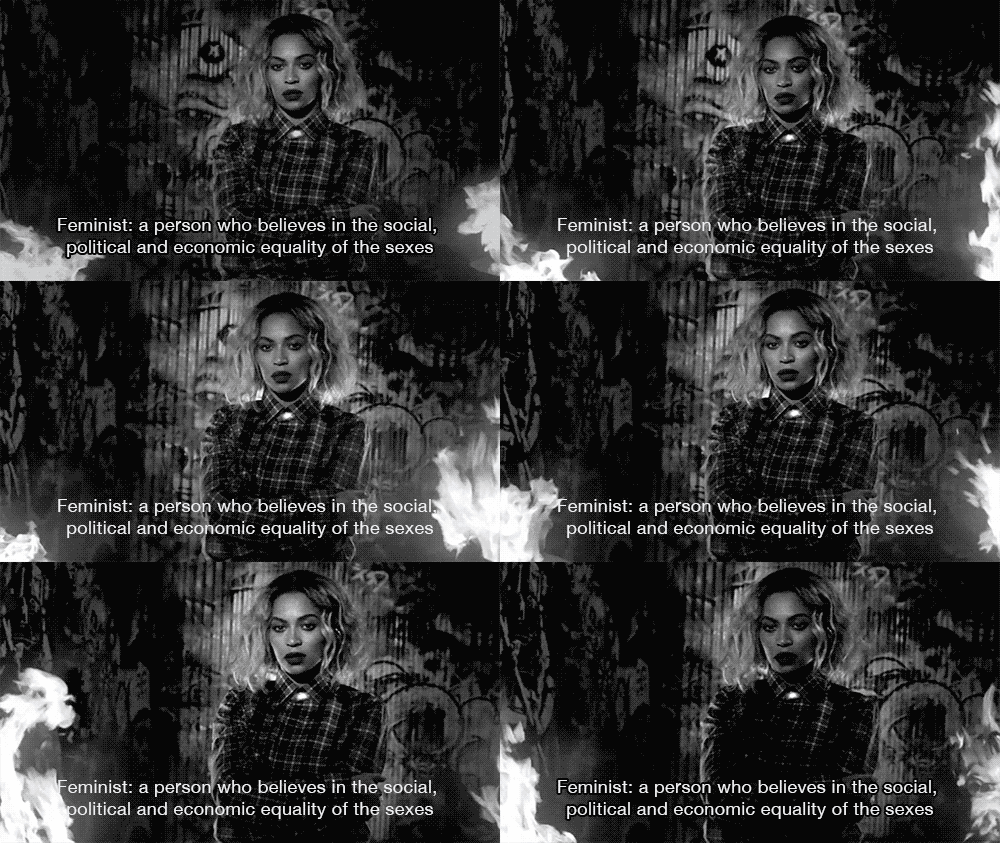
On Your Marx, Get Set..
Marxism is the belief that the upper class (or nobility) have gained too much power and are controlling everything, while the workers and the proletariats have lost their say in what the country should be doing. Karl Marx was one of the most influential philosophers in Russian history. He influenced many different pieces of literature, and Crime and Punishment was definitely one of them. The book captures the Marxist spirit because it tells the struggle of the Proletariat; almost all the characters are in a struggling lower class.
.
.
Existing in Existentialism
Existentialism is a philosophical theory or approach that believes in the existence of the individual person as a free and responsible agent. It says that people determine their own development through acts of the will. Throughout his life, Dostoyevsky struggled with the conflict between reason and faith. Crime and Punishment is about uncertainty, psychosis, realism, and introspection. What if social rules do not bound me? What if I am alone forever? What if nothing exists in the after life?
Subscribe to:
Comments (Atom)